

Regain your confidence with SMP carried out under medical criteria
Scalp micropigmentation in Madrid, at a medical hair clinic
Scalp micropigmentation in Madrid has become a treatment in growing demand among people who want to improve visual density, redefine the hairline or disguise thinning areas without undergoing surgery.
At FUExpert Clinic, led by hair medicine specialist, Dr. Juan Couto, we have refined the SMP technique with medical and artistic criteria to achieve a discreet, natural result that blends in with each patient’s features. We are not a chain that repeats the same protocol at every branch: before booking, you know who assesses your case, who treats you and which doctor signs off the criteria.
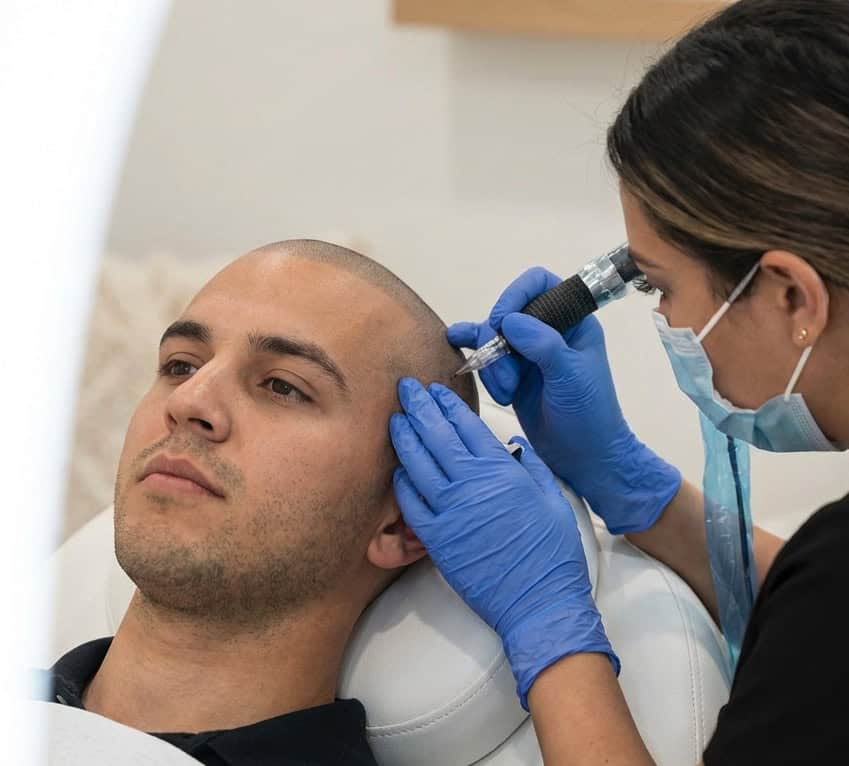
What is scalp micropigmentation? A medical view of the SMP technique (Scalp Micropigmentation)
Scalp micropigmentation, also known as trichopigmentation or SMP, is a non-surgical procedure that places microdeposits of pigment in the superficial layer of the dermis to simulate the appearance of hundreds of hair follicles.
But far from being a simple cosmetic tattoo, modern micropigmentation requires:
– anatomical knowledge of the scalp,
– an advanced aesthetic sense,
– millimetre-precise design,
– command of optical density,
– and technical precision with medical-gauge microneedles.
In expert hands, the result faithfully reproduces the “shaved head” look, or gives a real sense of greater density in areas with fine or thinning hair.
If you are looking for scalp micropigmentation in Madrid with a natural, realistic and clinically backed finish, this guide explains what you need to know.
Is scalp micropigmentation a tattoo?
It is not a conventional tattoo, although it shares the same principle: placing pigment in the skin. Scalp micropigmentation uses tiny dots at a shallower depth, because it aims to mimic follicles, not fill an area with colour. That is why the pigment, the needle and the technique all change.
The difference shows over the years. A dot placed too deep tends to spread and lose its shape, which is what creates the smudged or helmet-like look so many people fear. Depth control matters more to the result than the machine used.
Which pigments are used, and can they turn blue over time?
At FUExpert Clinic we use the best pigments on the market. You need to know that any pigment can shift to blue or green if it is unsuitable or placed too deep. That is why both the pigment and depth control matter, in every single dot and in every session.
In the European Union, Regulation (EU) 2020/2081 restricts the substances that tattoo and permanent make-up inks may contain. Always ask whether the pigment complies with it and request its technical data sheet.
The Advantages of Scalp Micropigmentation over Other Aesthetic Solutions
Trichopigmentation offers some benefits worth highlighting:
Immediate results
A visible change can be seen from the very first session.
No surgery or general anaesthesia
It requires no incisions, stitches or recovery time.
A complement to a hair transplant
It enhances visual density and improves the finish of the transplant.
Useful for scars and lack of density
An effective option for both men and women.
Micropigmentation has also become a useful complement for patients who have previously had surgery at our clinic, as it helps reinforce density, improve visual uniformity and enhance the results of the hair transplant.
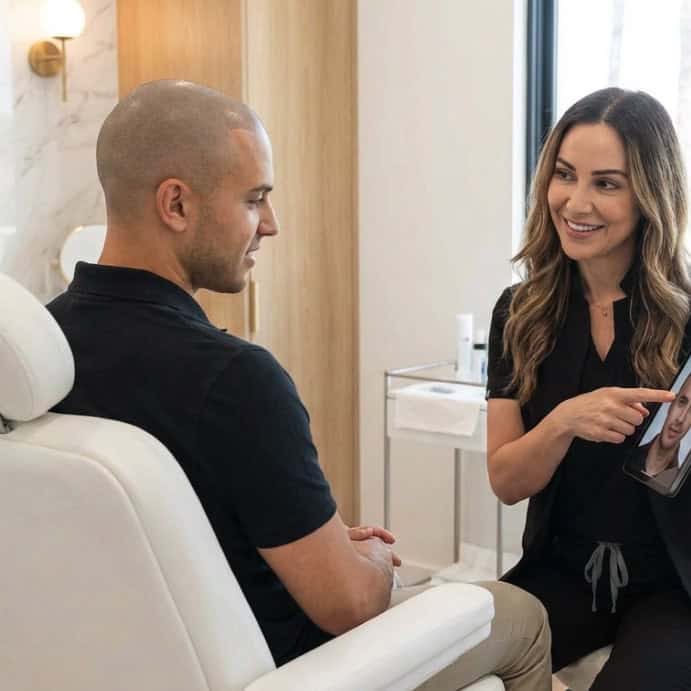
Medical-Grade Scalp Micropigmentation: Precision and Realism
What does well-performed scalp micropigmentation in Madrid look like?
Living with androgenetic alopecia or a loss of hair density affects not only your appearance but also your self-confidence. Madrid has many options today, but not all of them combine medical criteria with the art of hyper-natural realism. The difference between a result that looks natural and one that looks artificial lies in medical experience and in the precision with which the real follicle is replicated.
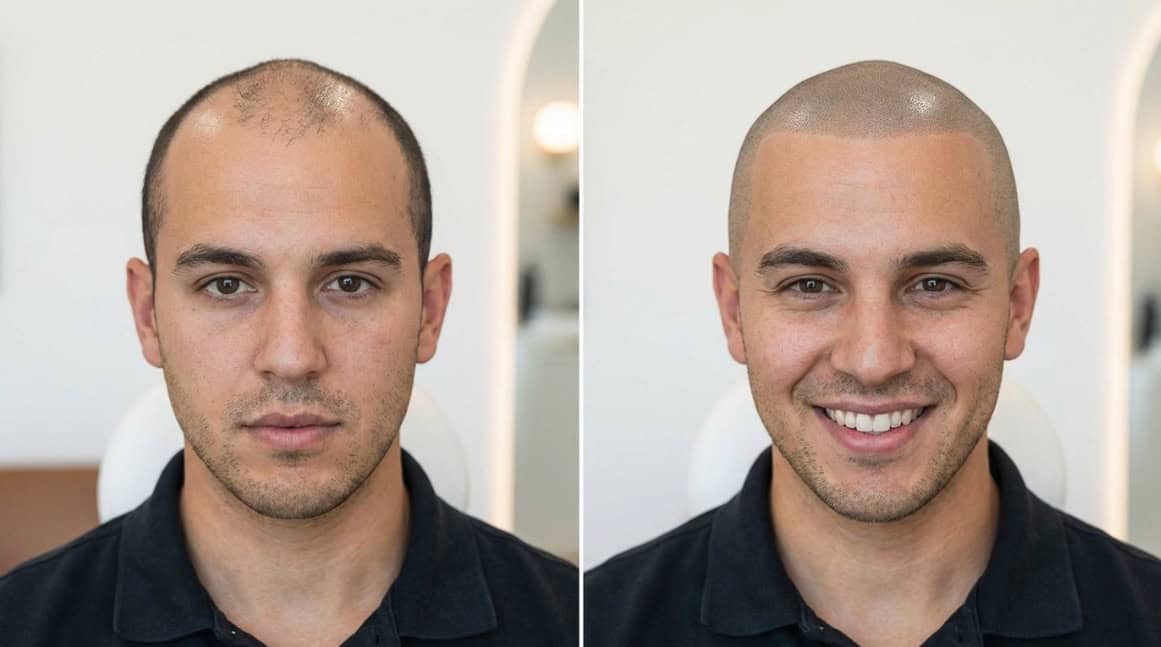
Why Dr. Juan Couto’s clinical vision makes the difference in your treatment
The key to scalp micropigmentation in Madrid that looks natural even up close lies in the design. This is where the leadership of Dr. Juan Couto becomes essential. As a hair transplant surgeon and ISHRS member with more than 30 years of medical practice, Dr. Couto brings his criteria for angulation, follicular distribution and hairline design to every pigmentation procedure.
We do not simply “fill in” bald areas; we apply medical criteria so that the follicle simulation is consistent with your age, your features and the future progression of your hair.
At FUExpert Clinic, micropigmentation is carried out under hair medicine criteria:
Many patients come to us seeking hairline restoration or crown pigmentation without the risks of an operating theatre. Our methodology rests on five pillars:
1. Anatomical design based on real proportions
The hairline is never improvised. It is designed taking into account:
- the patient’s age,
- the future progression of hair loss,
- facial symmetry,
- and natural growth patterns.
2. Angulation, depth and follicular pattern
Each dot must mimic the way hair emerges from the skin.
Too much density, oversized dots or the wrong orientation spoil the natural look.
3. Three-dimensional aesthetic integration
We apply a 3D effect that reproduces the size, shade and density of a real follicle.
This realism avoids the flat look of traditional tattoos.
4. Medical technology and pigmentation
Our pigments:
- are bioresorbable,
- are hypoallergenic,
- contain no heavy metals,
- are less prone to turning blue or green,
- and allow controlled touch-ups every 2–4 years.
5. Precise control of dermal depth
Medical micropigmentation is carried out in a specific layer of the dermis to avoid:
- pigment migration,
- dot spreading,
- or unwanted colour changes.
Three goals, the same criteria
Types of scalp micropigmentation for your case
People turn to it for three reasons: to wear a shaved head with a defined hairline, to disguise thinning hair or to camouflage a scar. Each one calls for a different design, dot density and commitment.
01. Scalp micropigmentation for a shaved look
This is the option when hair loss is advanced and you prefer to wear your head shaved, with the look of freshly clipped hair.
What matters most is the hairline. It has to suit your age and your face: at fifty you do not need the hairline you had at twenty, and a hairline that is too low or too straight is the first thing that gives the technique away.
Think about the commitment too. The shaved look means always keeping your hair very short: if you let the hair you still have on the sides or at the nape grow, the contrast with the pigmented area shows.
02. Scalp micropigmentation to add density
It is designed for people who still have hair but can see their scalp through it: at the crown, along the parting or across the whole top. The dots reduce the contrast between scalp and hair, so the area looks fuller.
It has two limits worth knowing. It does not add volume or thickness to the hair, and it does not stop hair loss: if the alopecia keeps progressing, the pigmented area may fall short over time.
That is why the assessment starts by understanding the cause, whether it is androgenetic alopecia or hair loss in women.
03. Scalp micropigmentation over a scar
It is used to camouflage scalp scars caused by an accident, surgery or scarring alopecia. The dots mimic the surrounding hair follicles so the scar loses contrast.
Scar tissue does not take pigment the way healthy skin does, so the result is less predictable. A thickened or very shiny scar may need more sessions or may not be suitable. That is decided at the assessment, by examining the scar.
If what you want is to have hair growing over it again, there is another route we also assess: covering the scar with your own hair.
Each session picks up where the last one left off
How scalp micropigmentation is done: sessions, pain and recovery
The process has four stages.
1
Assessment
We examine your scalp, decide whether it suits you and design the area.
2
Patch test
Pigment is tested on a small patch of skin to check tolerance and shade.
3
Sessions
Each one adds density and refines the shade towards the agreed design.
4
Follow-up
At 12 months, pigment retention is reviewed and any touch-up is decided.
How many scalp micropigmentation sessions do I need?
At FUExpert Clinic, 3 sessions is the usual plan, spaced one week apart. The exact number depends on the size of the area, the effect you are after and how your skin responds to the pigment. We work in layers, so shade and density can be fine-tuned gradually without overdoing it.
Session 1 (Base): The hairline is designed, then a first light layer of dots is applied to create the base structure.
Session 2 (Density): Carried out 7 to 14 days later. This is where most of the density is added, filling in gaps and matching the shade to your hair colour.
Session 3 (Refinement): Done a few weeks later to touch up any areas where the pigment may not have taken as well, even out the shade and add the final 3D finish.
Does scalp micropigmentation hurt?
There is some discomfort: you feel the needle, more in some areas than in others. It varies from person to person and from one session to the next. Topical anaesthetic is usually used. And you can ask for a break whenever you need one.
The first session is usually the most daunting because you do not know what to expect. After that, you know the feeling and arrive more relaxed.
Afterwards, you do not need a bandage or rest at home. Expect a few days of redness, small scabs and slightly tender skin.
Pain level: Far more bearable than a traditional tattoo, because the needle is finer and stays much more superficial (it only reaches the papillary dermis). Most clients describe a constant scratching sensation and rate it 3 or 4 out of 10. (The hairline and temples tend to be the most sensitive areas).
How many days until scalp micropigmentation stops showing?
Redness and small scabs usually stop showing 2-3 days after each session. During those days the shade also looks darker than it will end up, and it lightens as the skin settles.
If work is a concern, plan around your calendar: a session before a long weekend or a few days of working from home gives you some leeway. If you keep your head shaved, those days are more noticeable than if you have hair around the area. For a video call with the camera up close, allow 3 days.
Between sessions: after the first layer, the area looks lighter and less even than it will at the end. That is expected with layered work, because density is built up in the following sessions.
Final result: the final shade shows once the skin has fully settled after the last session. It is checked at the follow-up at 6 weeks, along with pigment retention.
Caring for your scalp after micropigmentation
The first few days decide how much pigment stays and in what shade. After each session we give you written instructions; these are the usual ones:
The legacy is designed on day one
How long does scalp micropigmentation last?
It does not last forever: at FUExpert Clinic, the first touch-up is usually done after 2-3 years. The pigment gradually loses intensity, faster if you get a lot of sun, sweat often or your skin renews quickly. A touch-up restores shade and density without starting from scratch.
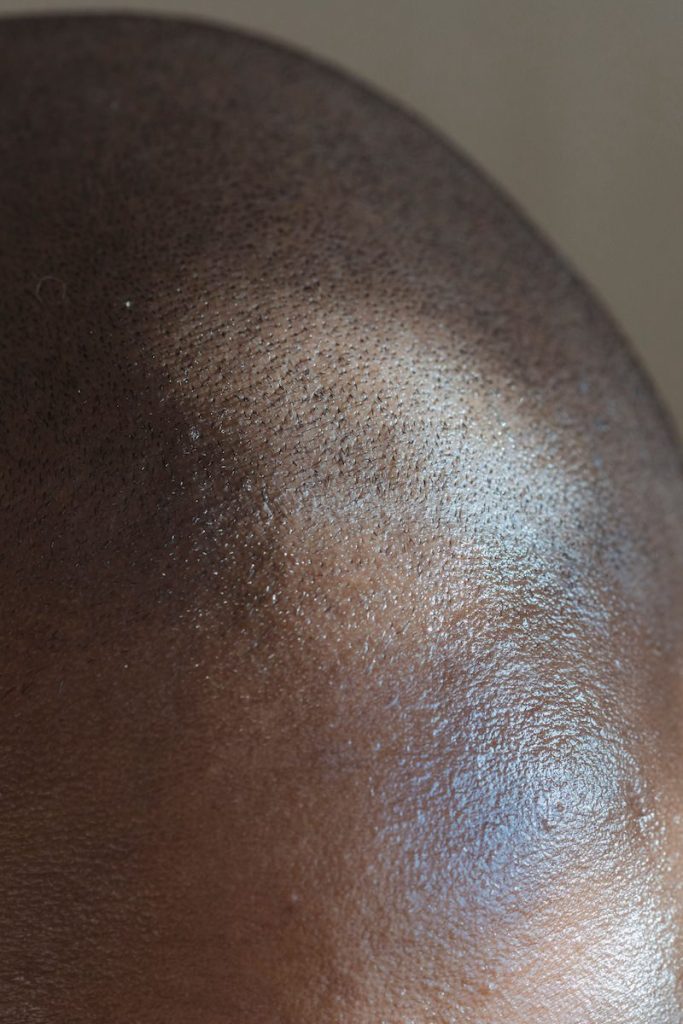
Scalp micropigmentation and grey hair: what happens over the years
Pigment does not turn grey; your hair does. Dots designed for dark hair can look too pronounced once the surrounding hair turns grey or white.
Touch-ups are done once the pigment has already lost intensity, and that is the moment to choose a lighter shade so it keeps matching your hair.
Something similar happens with hair loss. If it progresses, the pigmented area may need to be extended or have its edges softened. Designing with the next fifteen years in mind avoids having to correct a hairline that has ended up out of place.
Can scalp micropigmentation be removed?
Yes, it can be faded and, in many cases, removed, usually with laser over several sessions, although the process is neither quick nor always complete. That is why it is best treated as a lasting decision, starting with a conservative design: it is always easier to add density in another session than to remove any excess.
If you already have micropigmentation you are not happy with, bring it to the assessment. The first step is to see what went wrong: the shade, the depth or the hairline design. Sometimes it is enough to let the pigment fade and redesign over it; other times it has to be faded first.
Medical judgement before bookings
Who is a good candidate for scalp micropigmentation?
A good candidate is someone who wants visual density or a shaved look, understands that it will not bring back hair and has a healthy scalp. The assessment confirms it, and it may also conclude that now is not the right time or that the technique does not fit what you are looking for.
It is a good option if:
Better to wait or avoid it if:
When a clinic depends on filling its diary, saying no is costly. Here it is part of the job: these criteria are reviewed and signed off by Dr. Juan Couto, and if your case is not a good fit, we explain why.
TWO APPROACHES to HAIR LOSS
Scalp Micropigmentation or Hair Transplant:
Which Option Is Right for You?
At FUExpert Clinic, under the direction of Dr. Juan Couto, we do not see these treatments as competitors but as strategic allies. Choosing one or the other, or combining both, will depend on the degree of your androgenetic alopecia, the quality of your donor area and the aesthetic result you want to achieve. As a hair clinic in Madrid dedicated exclusively to hair restoration since 2012, we help you decide based on medical criteria of hyper-natural realism.
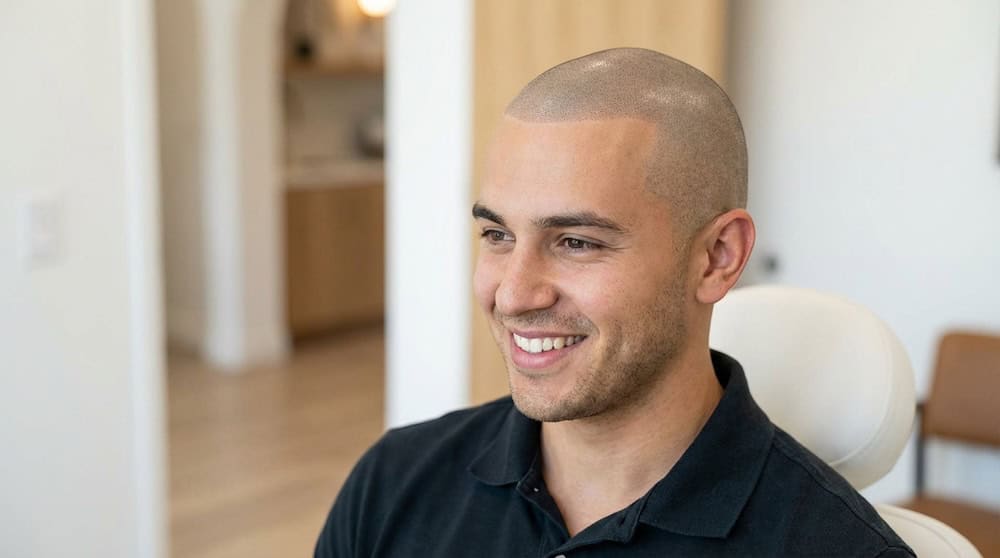
Hair Transplant: Recovering Your Own Hair
A transplant using the FUE technique is the route for those who want to style their own hair again. It is suited to:
- Restoring completely bald areas where the follicle has died.
- Patients seeking a tangible, lasting physical change.
- Cases with a healthy, plentiful donor area.
It requires surgery, recovery and a waiting period for the final result.
Scalp Micropigmentation: Hair Density Without Going Under the Knife
Advanced trichopigmentation is a non-surgical treatment that offers an immediate, visible change. It is a common choice for:
- Follicle simulation in patients who prefer a clean, modern shaved look.
- Achieving greater visual hair density on scalps with fine or thinning hair (especially in female hair loss).
- People who, for health reasons or by preference, want advanced hair aesthetics without surgical recovery times.
- Avoiding surgery
- Gaining density in fine hair
SMP does not grow new hair, but it creates a realistic optical illusion.
The Combined Treatment: Density from Both Techniques
Many of the before and after results that combine both techniques come from this synergy. Dr. Juan Couto often recommends micropigmentation as a complement to a hair transplant to:
- add visual density between the transplanted follicles,
- reduce the scalp-to-hair contrast at the crown,
- reinforce and define the hairline,
- camouflage scars from previous transplants,
- create a more even and natural finish.
This combination lets each technique cover what the other cannot.
Medical Technology for a Natural Look Up Close
Precision Technology in Scalp Micropigmentation (SMP) in Madrid
At FUExpert Clinic, we understand that the success of scalp micropigmentation in Madrid lies in what you do not see. That is why we have chosen our equipment so that every dot imitates a natural follicle as closely as possible. We do not just restore your image; we apply aesthetic engineering so the result looks natural, even up close.
Medical-grade pigments
Biocompatible pigments selected for colour stability, to help prevent bluish tones, with patient safety as a priority.
Precision microneedles
High-end instruments that place clean pigment deposits, preventing spread and always protecting the dermal tissue.
Three-dimensional follicle simulation
We recreate the angle and depth of natural hair with a 3D technique that gives each dot the look of a real follicle.
Blending and transition control
Artistic hairline design and soft gradients so that the pigmented area blends in with the rest of your natural hair.
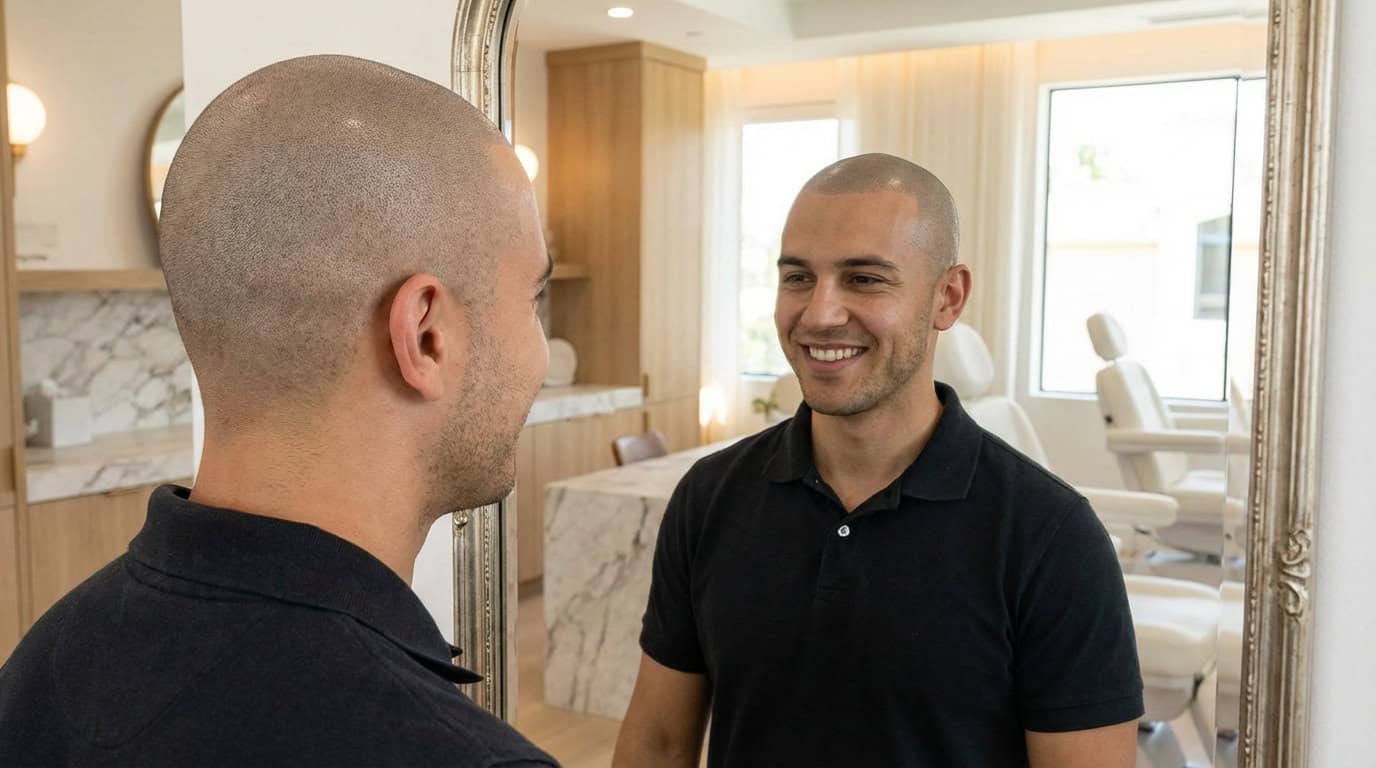
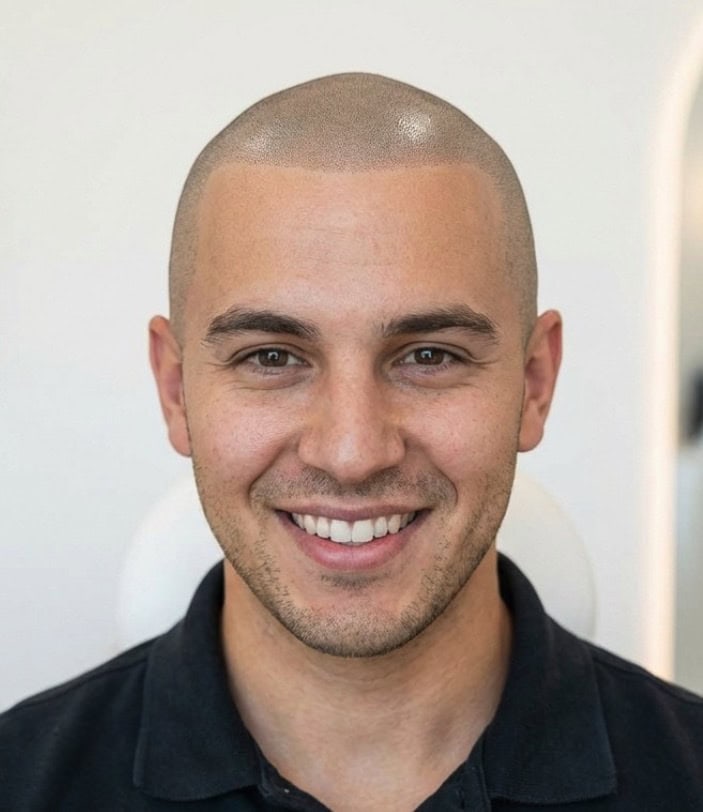
Everything you need to know about micropigmentation at FUExpert.
Frequently Asked Questions about Scalp Micropigmentation Treatment in Madrid
A legacy that began in 2010
Scalp micropigmentation clinic in Madrid: address and opening hours
FUExpert Clinic is in Aravaca, in north-west Madrid, within the Moncloa-Aravaca district. It is a clinic outside the city centre, in new premises. As micropigmentation is done over several sessions, it is worth knowing from the start how you will get there each time.
Clinic
FUExpert Clinic
Address
Av. de la Victoria, 94 · 28023 Madrid
Opening hours
Monday to Friday, 9:00 to 19:00
Saturdays and Sundays, closed
Languages
Spanish and English, plus other languages with an interpreter or translator
